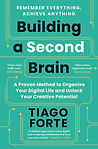
Building a Second Brain
A Proven Method to Organize Your Digital Life and Unlock Your Creative Potential
May 30, 2025
Tiago Forte
#Digital Organization, #Notetaking, #Personal Productivity
Download Summary Map
Brief summary
Building a Second Brain describes a digital knowledge management system that helps capture, organize, and effectively use information. The method is based on the principles of CODE and PARA. The goal is to create a personal "second brain" that stores ideas in a structured way, makes them easily accessible, and facilitates creative work. This results in a clear, stress-free path to transforming knowledge into productive outcomes.
General ideas
Collect notes where you can find them when you need them.
Break the work down into small steps
Don't spend too much time on summaries.
Plan projects in such a way that you don't have to do everything yourself.
Create conditions that allow ideas to emerge
Standardize work processes to improve them.
Utilizing the creative process: capturing, organizing, distilling, assembling
Archipelago of Ideas: A method for project work. At the start of a project, previous ideas and notes are collected so that they can be easily combined later. Regular collection creates a reservoir of ideas that facilitates new projects.
Hemingway Bridge: End each work session with a note about the next step. This makes it easier to get back into the flow and keeps the workflow smooth.
Avoid "heavy lifting": Break down large tasks into small, manageable steps. This makes work easier and more manageable.
Contents
CODE method
A method for better knowledge retention, connecting ideas, and working with less stress. It consists of four phases: Capture , Organize , Distill , Express .
Capture
Capture only truly remarkable ideas that spark curiosity, joy, or wonder. Keep what is unusual, interesting, or useful. Make capturing a daily habit.
What to include: passages from books, podcasts, courses, or spontaneous thoughts. Quotes, facts, images, voice memos, or links. No sensitive information.
Criteria:
Retain only valuable content
Copy a maximum of 10% of the original.
On average, 1 to 2 notes per day
Inspiring, useful, personal, or surprising
Tools: note-taking apps, read-later apps, web clipper, transcription tools
12 Favorite Problems
Keep a list of up to twelve problems you want to solve. Compare new information with these topics. Choose open-ended and specific questions that spark curiosity. This will help you identify connections between seemingly unrelated ideas.
Organize
Structure your notes so they are action-oriented. Use the PARA method for clear organization.
PARA method
The PARA method is used for all digital storage locations – documents, cloud storage, and notes. It divides information into four categories:
Projects:
Short-term goals with a clear completion date, such as writing an essay or planning a trip. Five to fifteen active projects are recommended.
Areas:
Long-term responsibilities or interests without a fixed end, such as finance or writing. Define standards to maintain direction.
Resources:
Collections of information without a goal or deadline, which might be useful later, such as a hobby.
Archive:
Completed or paused projects that are removed from the workspace but kept on file.
Application: First, jot down notes, then sort them weekly. Everything goes where it will soon be useful. This saves time on labeling and tagging.
Distillation (Condensation)
The goal is to reduce notes to their core. Summarize the essentials concisely so you can find them again quickly.
Ask yourself: How can I make this more useful for my future self?
Progressive summarization
A method with multiple compaction levels:
Highlight important passages in bold
Highlight key points
Write a short summary
This allows for flexible decision-making on rereading, allowing for a choice of how deeply to delve into the text. The original is always preserved.
Tips:
Highlight only 10 to 20 percent
Use intuition to identify the important passages.
Make a note understandable in under 30 seconds
Express (Express)
Knowledge becomes skill through application. Share your work to receive feedback. Create "intermediate packages" —small, prepared work units that are combined at the end. This way, a project is created without overwhelming you.
Share interim results early to get feedback. The goal is to complete projects efficiently and without stress.
Divergence and Convergence
Two operating modes that should be separated.
Divergence (openness): Gathering ideas, absorbing new influences, exploring different perspectives, and engaging in conversations.
Convergence (focusing): Sorting and reducing ideas, and selecting the essentials.
Tips:
When diverging, open windows, jump between sources, follow your curiosity.
When converging, close doors, avoid distractions, and maintain focus.
Habits for digital organization
Routines help keep the system functioning. Conduct a weekly review once a week and a monthly review once a month.
Weekly review:
Clear emails
Check calendar
Clear notes inbox
Set tasks for the week
Monthly review:
Check PARA structure
Reassessing areas of life
Check the feasibility of long-term ideas
Project checklist
Reuse materials from old projects to start new ones faster.
Project start:
Create an overview of the scope and required information
Browse relevant notes
Move or mark relevant content
Create structure and process plan
Duration: 20 to 30 minutes
Project completion:
Mark project as completed
Sort results for reuse
Identify areas for improvement
Duration: a few minutes to hours
Application steps for the second brain
Set goals
Set up the notes app
Setting up the PARA system
Develop a data collection routine
Apply progressive summarization
Conduct weekly and monthly reviews